W Hobby Ltd

W HOBBY LIMITED, KNIGHT'S HILL SQUARE, LONDON, SE27 0HH
Enquiries: 020 8761 4244 Fax: 020 8761 8796

Casting Chess Pieces

Ian Peacock investigates the art of DIY chess sets.

Nobody knows for certain where and when the game of chess first originated. In fact there are several claims to the time and venue of the first chess championship, one of which is said to have been at the Great Exhibition at Crystal Palace in 1851 organised by Howard Staunton who was famous for his design of chess pieces.

Although many legends abound, many attributing the origins to the Biblical King Solomon, or the Greek God, Hermes, most likely the game dates back to around the 6th, or 7th century AD, and many would say that it originated in India. However, it crossed the border into Persia, and then to Europe.

The word "Chess", is thought to have derived from the Persian word "Shah", for king, and "checkmate" from "Shah mat", meaning "the king is dead!" Whatever the beginnings, few would dispute the fact that it is probably the most widely played game in the world, and became one of the first of the "traditional" games, to be brought out as one where the enthusiast could play against a computer.

For all of it's current computerisation, the traditional, (and some modern!) chess pieces are still considered a part of the household decor in homes where the game is rarely played, and the acquisition of a classic chess set, nowadays, puts one into the position of owning a valuable piece of art decor. As hobbyists, the production of one's own chess set has always had an attraction, and in today's environment, such production is within the reach of almost anyone. Modern moulding and casting techniques have reduced the problem of multiple copies, (i.e. lots and lots of pawns!!) to a level of unbelievable simplicity. Not only that, but the materials from which they can be made varies, too.

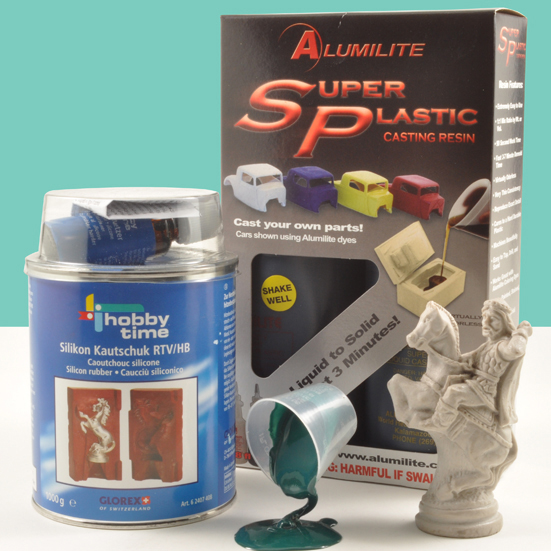
For the most part, chess sets are cast from plaster of Paris, glass fibre resins, or low melting point metals. In the majority of cases, simple rubber moulds are the starting point for such casting. Regular readers of this august journal will already be aware of the techniques used to create one's own rubber moulds, previous issues of the Hobby's annual having covered the subject in detail. From this, it will be evident that, given a classic chess set to copy, it is a simple matter to make your own moulds. Simpler still, is the use of ready made, proprietary moulds, and moulding compounds, to shortcut the entire affair. For resin and plaster cast chess pieces, there are a range of silicon rubber moulds, available from Hobby’s and other sources, that put you firmly in the drivers seat, en route to success. Simply chose a style that you like, and make with the casting!

Plaster of Paris

Provided that you have a reasonable quality of plaster, then casting your chess pieces is very straightforward. Stone plaster is best, for it sets to a much harder, and knock resistant finish, than regular plasters. The flexible rubber moulds require to be supported, inverted, while pouring and setting and a suitable support can be made from either scrap balsa wood, or cardboard. It is worth taking a little time over this and ensuring that the support can carry the weight of the whole range of moulds at one time, (usually six or seven, in a chess set!), for, in practice, it is normal to cast several pieces at one go.

Mix up the plaster according to the instructions and pour carefully into each mould. Because of the complex shape of many of the pieces, it will become necessary to gently “work” the mould between finger and thumb, to ensure that it is totally filled, with no air pockets trapped in the nooks and crannies. Mix up enough plaster to fill all of the moulds, and start by filling the pawns, as there are obviously a lot more of these than the other pieces. Should you run out of mixed plaster before all of the moulds are full, do not worry, for when you do the next set of pawns, you can fill those moulds that were not used on the first pour.

It will pay to get your head around what you are doing, before you start, and figure out the order of moulding, so that you finish with the correct number of each piece.

In general, it will pay to fill the mould to the brim and not to skimp on the plaster by filling only to the base line of each piece, for as the plaster sets, it shrinks, leaving a pronounced "dimple" in the base. Furthermore, a more solid, oversize base is handy, when removing the piece from the rubber mould, and when handling it during the finishing stage.

Most plaster chess pieces wind up being painted, not only from the appearance point of view, but also to seal the somewhat porous nature of the surface. Most model paints are adequate for this, and we have brush and spray paint with cellulose, enamels, oils, and acrylics. However, if you just want to clear lacquer the plaster pieces, you can dye the raw plaster with a water based colourant. (Try a couple of drops of food colouring!) Alternatively, the translucent acrylics, such as the Tamiya clear colours work well.

Finally, the oversize base of each piece needs to be cut off to the required height, and sanded smooth. ( A modellers band saw, and power sanding wheel is an efficient, if messy shortcut, here!) An additional touch is to glue coloured felt to the underside of each base.

Resin Casting

The same basic premise holds good here, with one or two extra reservations. Casting resins are a two part mix, and the two parts should not be mixed until totally ready to pour. However, adding bulking agent, and colourant to the base resin can be done ahead of schedule, and is a preferred route, leaving the resin to stand for an hour or so to let any air bubbles (trapped as the result of mixing), rise to the surface.

Unlike plaster, there is minimal shrinkage with resins, and therefore, there is less need to overfill the mould. In addition, resins are a great deal harder than plaster, and are therefore more difficult to sand smooth on the base. Experimentation with a couple of pawns will highlight this problem.

In general, resins of this kind can be used for a myriad of other modelling jobs, and therefore, it might be prudent not to mix up the whole quantity with either the bulking additive or the colourant, but only mix up that which is required for one or two pourings, (adding the hardener to the premix, just prior to pouring.) Again be careful to fill each mould completely, or malformed figures will result.

Metal Casting

Metal casting kits can also be found in this Annual. Here, the principle is the same, but there are one or two specific areas to watch out for.

Molten metal, even low temperature metals like these, are hot, and more care in handling is required to avoid burning yourself, or damaging kitchen surfaces. Furthermore, the types of rubber used in moulds for metal, are not those used in cold casting, and these cold cast moulds must NEVER be used with metals.

Once more, following the instructions to the letter will afford the necessary skills, and regard to safety, that are needed to achieve satisfactory results.

One small problem that you might encounter is that many of the chess pieces are of quite complex shape, and lie on the slant within the two piece mould. In some circumstances, you may well find that the molten metal does not find its way into some of the uppermost corners of the mould resulting in there being "bits missing" from the finished piece. This can be simply overcome by cutting additional metal feed channels in just one side of the mould to carry metal from the main feed channel into those areas that do not fill. A sharp modelling knife is all that is needed to add these narrow channels. Unlike plaster and resin, poorly moulded pieces in metal are not waste as they can be re-melted, together with the removed filling "gate" material, and re-used.

Finishing

All mouldings need to be allowed to set, plaster being best left overnight, resin being handleable within a couple of hours, and metal when it is cool enough to touch. (Usually five minutes or so is sufficient!) To release the pieces from the moulds does require a slightly different technique, dependant upon the material used for the casting.

Metal castings just require the two part mould opening, and the piece removed. A small saw or snips may be used to separate the moulded piece from the runners via which it was filled, and a small file, or emery board used to smooth off the base. Finishing then is just a matter of polishing the bare metal, or painting it for contrasting colours. Again, clear lacquers may be used to enhance the finished product and to prevent the bare metal from tarnishing, with age. (Unless you deliberately want to let them tarnish, to make them "look" old!!)

Resin moulded pieces require to be removed from the mould by peeling back the flexible mould and revealing the finished article. A touch of dilute washing up liquid, smeared on the outside of the mould will enable it to be rolled back over itself, until the chess piece just pops out. A further application of the washing up liquid to the mould, will allow it to be rolled back to being the right way round. Resin, being that much harder than plaster, enables a fair degree of force to be used during the extraction process, but don’t go too overboard, here, or you can wind up tearing the rubber mould. Plaster pieces need to be handled a little less roughly but should release from the mould in exactly the same way. Most resins harden with a slightly sticky surface. This is of no consequence and can be removed with methylated spirits, or acetone. (Nail varnish remover!)

Copyright © 2007 W Hobby Limited