W Hobby Ltd

W HOBBY LIMITED, KNIGHT'S HILL SQUARE, LONDON, SE27 0HH
Enquiries: 020 8761 4244 Fax: 020 8761 8796

Magic Masonry

Ian Peacock investigates the "Magic System".

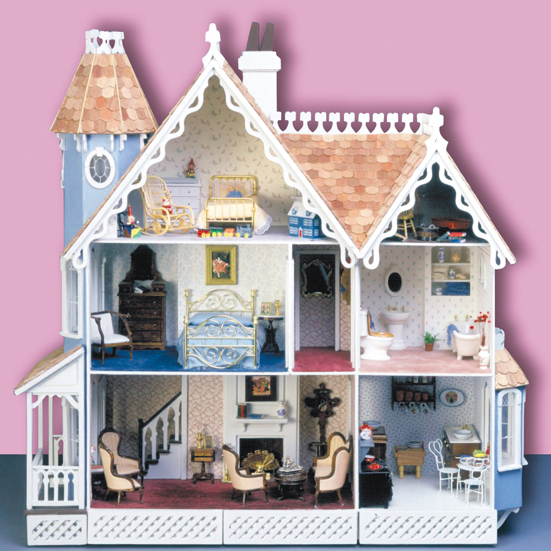
In the world of doll's house modelling, it is probably fair to say, that from the very beginner, upwards, there is a constant quest towards the ultimate in realism.

From the architecture and design, to the furniture and fixtures, we all strive to get it "to look right". And nowhere does this search for the perfect appearance take more precedence than the structure of the building, itself.

Although the basic structure of the average doll's house is, by nature, somewhat of a slab sided affair, the effort that we all put into it to improve the inner and outer surfaces, is immense. Fancy patterned wallpaper on the inside, and fancy brick or stone paper on the outside, is the starting place for most of us, although, as we progress, we seek greater authenticity. There are a variety of products on the market, that allow us to achieve such an authentic appearance, and just one of them is the magic masonry that comes from "Magic Systems".

Magic systems seeks to combine the well proven path of casting in plaster, with the equally well proven "stencil", widely used by the airbrush enthusiasts. In fact it uses pre-cut self-adhesive stencils as the contour for moulding plaster to pre-ordained shapes, sizes and patterns.

In use it really is too simple for words, all you need to do is peel off the pre-cut paper stencil from it's backing sheet, (carefully, and avoiding any distortion!), and stick it onto the face of the subject that requires the surface finish. This could equally be the outside of the building, in either stone or brick, (dependant upon the style of the house), or internal features such as rough stone walls, fireplaces, or other decorative features. Not only walls, but flagged floors, stone patios and garden paths, and even specialist garden furniture, ponds, and bird baths.

Once the stencil has been smoothed down, the plaster is simply poured over the stencil, to the level of it's upper surface, (or a little over), smoothed off and left to set. When it is touch dry, but not actually hard, the stencil is removed to reveal the plaster standing proud of the surface.

Of course, as with all aspects of our craft, a little forethought goes a long way, as does a bit of practice! It is soon patently obvious that the grooves between the bricks, stones, etc., will show through between them, in the colour of the base material. Therefore, it will pay to paint the bare wall, floor, or what have you, with acrylic paint of the sort of colour that you wish the gaps to be.

The mortar in walls, and floors may be a natural, grey, cement colour, or may well be highlighted, (often in white or black!), to create a decorative effect, and this should be your starting point. Whatever colour you chose, try to use matt paint, or use a coat of matt clear over gloss paint, as plaster does, in general, tend to adhere better to the rougher surface of matt paints.

While most plaster is white, and certainly that is true of the stuff that comes with the Magic System sets, it can easily be coloured either while it is still runny and has not been poured, using any proprietary water based paints, or when still in powder form by adding dry poster paint.

Alternatively, the surface may simply be painted when the brick/stone work is all completed. Maybe a mixture of both approaches has the best mileage, the base colour being added at the beginning, and gentler tinting applied to the finished work to destroy the "new", and "all the same" look that will come about, fresh from the packet.

Magic Systems stencils come on a roll some 3" wide, and where large areas are required to be surfaced, it will be necessary to lay up several layers, of the stencil, side by side. It becomes very obvious when you do that, that it is necessary to align the "pattern" correctly, (like lining up the pattern on wallpaper!), so that the rows of bricks, or stones, are all to the same pitch, and bond. Overlap one "mortar" layer of the stencil on top of the existing layer, to produce an evenness of alignment. Equally obvious is the problem of working around a corner, and if you get the pitching right on the first row, you may be able to fold the stencil around the corner, onto the adjacent side. Should this not be possible, by virtue of the shape and style of the corner, then care must be taken to set up a new stencil on the adjacent wall, such that the bonding and pitch is correct. (i.e. If the row of bricks on the front finishes with a "whole" brick, then the row on the end must start with an end brick!)

Another point to watch is that as the plaster dries out, the stencil needs to be lifted. This can often be done with the point of a scalpel, taking care not to damage the end brick. (Although "distressed" brick or stone work is another option!) Better to cut the stencil a 1/2" or so longer than the wall, such that you can grip the overhang to start pulling off the stencil.

Although stencils, as supplied, will cover most situations, "non standard" work can be obtained by modifying the stencil. For random stone, for instance, you can cut away sections of stencil to created larger and odd size stones. For garden paths of differing formats, adding strips of cut off stencil to the pattern of the stock stencil, (after it has been stuck down of course!), can produce random stone work. Be careful here, however, for when the stencil is peeled off, all of the little additional pieces will need to be removed individually, with the point of a scalpel.

In general, it is not a good idea to get the plaster on too thick, about 1/16" seems to be the maximum, although you can be a thin as the paper stencil it's self.

This form of stone/brick/flag creation is not limited to walls and floors. The idea of coating pre-made wooden blocks, then assembling the finished item, opens up such subjects as brick or stone fireplaces, and stone/brick/concrete garden furniture. Simple brick built barbecues, stone bird baths, and concrete benches, now all take on a new dimension.

Another tip, for stone paths, is to take less care in smoothing the plaster over the stencil. (A palette knife works well for this!), in fact roughening the surface, as it is drying will create a more "rough hewn" appearance. Experimentation with the thickness of the mixed plaster, and the degree to which you let it dry before smoothing it out, can drastically alter the appearance of the finished work. Further experimentation with a domestic hair dryer, held close to, and moved back and forth across, the drying plaster, will yield air bubbling that will cause the dried surface to pitch up and dry more like random stones. Before commencing work on the subject, proper, it is worth a couple of dummy runs to determine the best consistency of the plaster, and the best time to pull off the stencil. This will usually be around the 3-5 minute mark, but rarely longer.

Anyone who has used plaster of Paris, before, will know the consistency for which to aim, and it is basically similar here. In general, it doesn't pay to mix up too much at a time, for although you can add more water to plaster if it starts to go off, this is not the most satisfactory route to go. Finally. plaster of most sorts picks up dirt over a period of time, and a sprayed on coat of matt, or satin lacquer, will seal the finished work, and will tend to make it a bit more finger mark resistant.

So, if you have got to that stage in your doll's house building career where you are looking to add that extra touch of surface finish that "looks right", then look no further that the Magic System route.

Copyright © 2007 W Hobby Limited