by Ian Peacock
Have you ever made something from Plasticene and then wished that it could be a bit more permanent, so that you could keep it? Well, I have, and on more than one occasion I even tried to varnish or resin over it, to prolong its life. Now all that has changed! I've discovered DAS!!
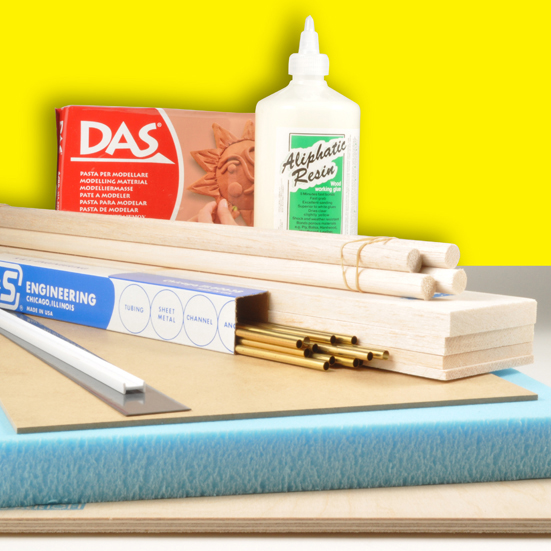
DAS is, to all intents and purposes, a modelling clay, similar in many respects to many others. However, unlike many of the others, DAS sets hard and therefore will last as a finished product, virtually indefinitely. Now I know that there are other modelling clays that can be hardened, usually by baking them in an oven but DAS hardens on its own if just left to stand. The only down side of this is that any unused DAS must then be stored in an airtight container. If reasonable care is taken with the re-packaging after use, DAS should still be in workable condition, when you come to use it, next time. (We found that keeping it in airtight plastic containers, with snap on lids, an excellent method!)

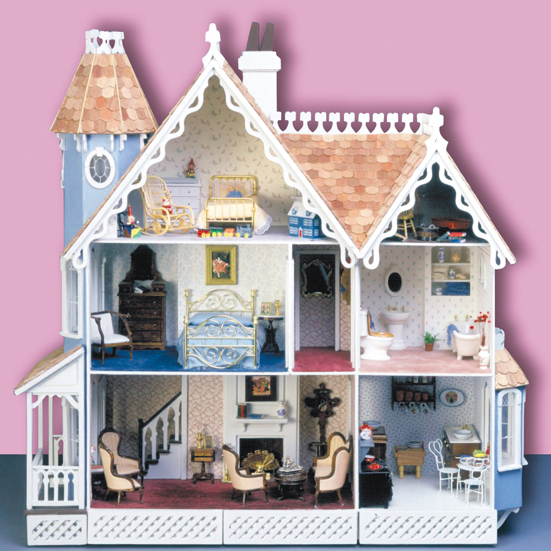
Although it would be fair to say that this product really is "child’s play", (my grand daughter has had a wonderful time with it!) there are many "grown up" uses for it too!! Doll's house enthusiasts, for example, will find it of particular interest, for it enables them to create permanent parts, and fitments, as easily as they would have made moulding patterns in Plasticene. True, if the requirement is for "many" identical copies, moulding is still the best route, for ones and twos of any item, DAS cannot be bettered. Sculpting fruit for the bowl on the table, (and even the bowl, itself!), custom carving decorative ceiling roses, and even sculpting hands, feet and heads for figures, all fall readily to the use of DAS.
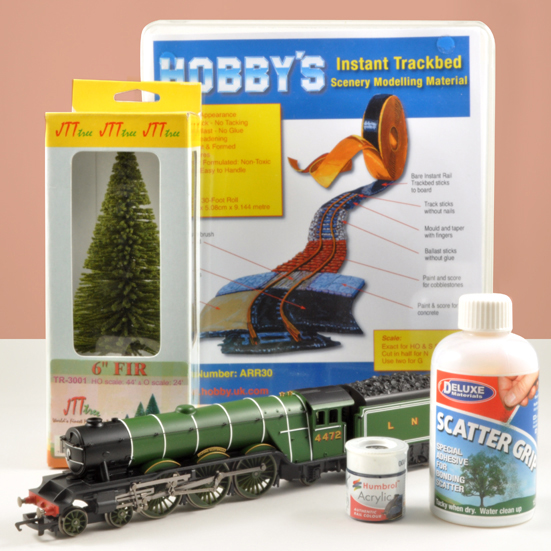
Model railway fans will also be quick to seize upon the advantages of DAS for a myriad of uses. Facing cardboard or balsa wood buildings with DAS, enables stone or brickwork to be scribed into the soft clay, which, when hard, is virtually permanent. Trees, rocks and boulders, pathways and roads, and many other landscape items also fall naturally into this ability to mould and carve easily while the clay is still soft yet have rigid, handleable products once the clay has hardened. Working DAS with the point of a needle, tip of a nail file, or even purchasing a set of proper implements, will quickly demonstrate the versatility of the clay and it is probably fair to say that any technique successfully used with conventional modelling clays, can be used here, too.

Wetting the finger with just a touch of water will soften the surface and allow the clay to be smoothed as it is worked. However, do go easy on this, for too much water renders the whole thing far too "squidgey" to work!
There is no need to rush, for DAS does not set in seconds. However, there is a definitive setting time and practice has shown that it pays to try to finish any given part of a project in no more than two or three hours. DAS sets hard overnight, however, again this is not a definitive figure and leaving it for a couple of days is no bad thing.
Small items can be made to "stand alone"” but larger modelling subjects, will benefit from some form of underpinning. Mention has been made of card or balsa, but soft wire is also useful. Making up a "skeleton" of soft florists wire, twisted together, is a good place to start, say, trees, or a figurine, building the DAS layer by layer, and limb by limb, until the desired thickness and form is obtained. For larger figures, there is some mileage in applying an overall "master" layer, in order to form the basic shape, and when dry, adding the surface finish and detail layer, piece at a time, working up the final shape and texture to suit.

DAS comes in only two colours, grey and terra cotta. (This latter colour is particularly good for flower pots and garden ornaments, in both doll's house scales and in model railways!) but, when dry, it is an easy medium to paint. Heavy water based paints may be added in small quantities to the grey clay, to change the colour but the results tend to be a bit dull. While this might suit some applications, others may well benefit from brighter colouring. When hard, DAS takes most paints well. Enamels, and the current crop of model acrylics, seem to work well, although one suspects, many of the art and craft paints would be equally effective.
So, once again the list of "really useful" hobby materials has expanded. Gone are the days when it had to be made from cardboard, balsa wood and papier-mache! Today’s materials technology has spawned many new and immensely useful products. If you haven’t tried DAS, yet, you might just be missing out on just one such product.
Copyright © 2007 W Hobby Limited