Here is an example on how to produce a silicone mold. In this example, we will walk through the process of making a 2 part mold.

1. The first step is to create your original. (Believe me, this is the hardest part)
2. Decide where you want your parting line. Try to put this in the place where it will be noticed the least. As you can see in the middle picture, we have drawn the parting line down the side of the bear to avoid seeing it from the front.
3. Take the synthetic clay and embed the bear to the white line on your piece (as shown in the third picture). If the clay is too firm, warm it in an oven or microwave to soften it. It is vital that you use synthetic clay. Sulfur based clays can inhibit the curing of you silicone rubber and ruin your mold.

4. Now that you have your clay built up to the parting line, create your mold box around your piece. The box can be constructed out of many different materials. We have used corrugated plastic in this example. Some other options include plastic cups, boxes coated with plastic wrap, and even Lego. Carve a small trench in the clay that surrounds your piece. This will create a "marker" so that both halves will fit together perfectly.
5. Make sure you have completely cleaned your original with soap & water and/or rubbing alcohol. This will help eliminate any residue that my inhibit the curing of the silicone. When the box is complete, mix and pour the silicone rubber over the original. Patch any leaking areas with the clay. All of the Hobbytime silicone that we carry requires the addition between 2% and 4% of catalyst (measured by weight). Be certain to completely mix your silicone, because any portion that isn't mixed will not cure. By adding only 2% of catalyst the mould will take longer to cure but will exhibit much more flexibility. 4% Catalyst will speed up setting time but reduce flexibility.
6. The rubber will be fully cured in 24 hours. When fully cured, remove the cured rubber and the original from the mold box. Start to remove the clay by hand. Use a toothbrush to remove the clay in hard to reach areas. DO NOT REMOVE YOUR ORIGINAL FROM THE RUBBER! This will break the tight seal and may cause additional rubber to flow into the areas that are all ready cured.

7. Once you have completely removed the clay, coat the rubber with a thick coat of rubber to rubber mold release. This will prevent the second layer of silicone rubber from sticking to the first. This will dry fairly quickly. DO NOT MOLD RELEASE THE ORIGINAL. Be sure not to miss any rubber sections of your mold. Any area not coated with release agent will stick and will require excess cutting to pull the two halves apart.
8. When the second layer dries (24 hours) you are almost done. Separate the 2 pieces.
9. Now all that's left is to get a pour hole. Get an X-Acto knife and cut a hole where it will be the least noticeable. This will produce some excess resin that will protrude from the hole, so make sure it is in a inconspicuous location. As you can see, there are some vent holes cut in the bears left hand. This will allow excess air to escape that would otherwise be caught in the undercut and cause a visible air pocket. Use these only if there are constant problems with air entrapment.
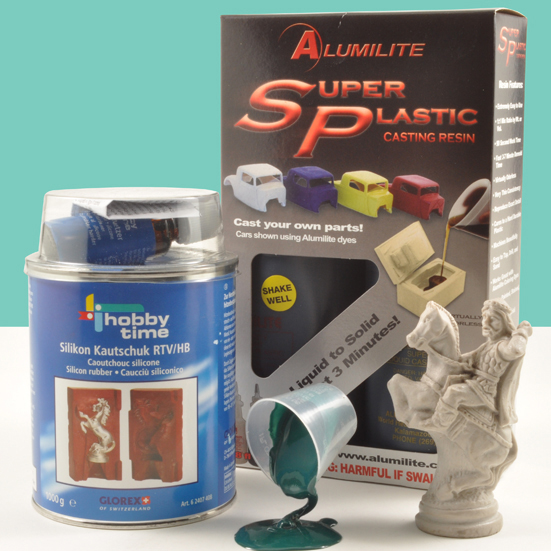
10. Now you are ready to mix the Alumilite Super Casting Plastic and begin reproducing your original.
11. The above information is also applicable to the manufacture of moulds for casting white metal components (see note below)
12. Which type of rubber should I use?
For casting Resins (Alumilite etc.) and plasters you should use White Silicone Rubber, Hobbys Part No's; 6407, 6408. This rubber can also be used to cast resins, plasters etc.
IMPORTANT! White silicone is not suitable for use with white metal.
Copyright © 2007 W Hobby Limited